As we move into the off-season for hockey players, what is the appropriate training frequency?
It’s normal to feel the pressure to do more than the player next to you.
To get ahead, we feel we need to do more. Work harder. No days off.
But how much is too much. And what happens when we over shoot that?
What Happens When We Train?
When we train, whether it be on the ice, the track or in the gym, we create a stimulus for our body to respond to. That stimulus creates fatigue, which our body needs to recover from. How long it takes to recover can depend on the type of training and other factors. Things like sprinting and really heavy lifting are harder on our body and specifically our central nervous system. Moderate lifting, single limb work and aerobic training are easier on the body and nervous system.
When deciding on training frequency, each stimulus has to be considered both individually and together to make sure we get adequate recovery. This is where having a qualified and thoughtful coach is critical.
Why Does Recovery Matter?
The reason we lift weights, is with the hope of getting stronger. The reason we sprint, is to get faster. This is called an adaptation. The thing is we don’t adapt when we train. We adapt when we recover.
If you look at the image below you can see the periodization model called supercompensation. This is where the recovery period is sufficient to match the training frequency and intensity, resulting in adaptation that leaves you either bigger, faster, stronger or more conditioned than where you started.
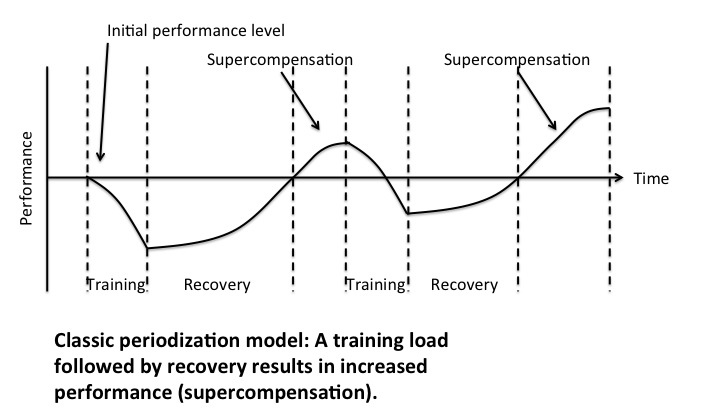
It is during the recovery periods when the adaptations are actually taking hold. If you interrupt that recovery period, or don’t have the resources to recover, then you will miss out on some or all of those potential adaptations.
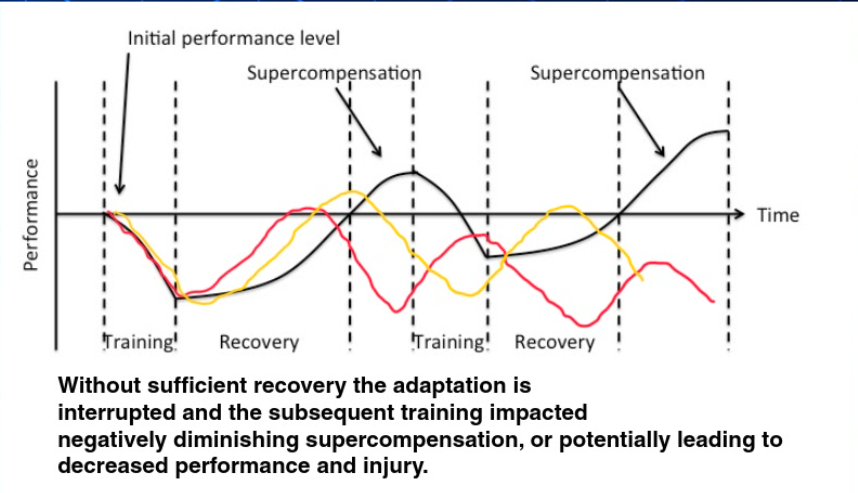
Above, the yellow line represents not ideal recovery. Some supercompensation is happening but the training frequency is not optimal.
The redline represents overtraining. The recovery is not only interrupting adaptation before supercompensation can occur, but performance is actually diminishing. This is often what we see in season when all factors are not consider in the training program, or in the off-season with overeager athletes.
The redline approach is not only diminishing our potentials gains, but it also leaves us vulnerable to injury and illness. As our central nervous system becomes over taxed we can experience reduced coordination, mental focus and reaction time, all of which leave our body at risk. This is why many serious non contact injuries happen late in games, or during long stretches of games.
What is adequate recovery?
Recovery isn’t just the absence of training. It is the presence of sufficient fuel intake, sleep and mental breaks. And actually we can still train without interrupting the supercompensation adaptation. We just have to be thoughtful about it.
Games, practices, speed sessions, the gym. All of these things impact our ability to recover and have to be considered when laying out our off-season development plan.
By manipulating which type of stimulus we are training, we can have a high training frequency without sacrificing gains, or risking injury. This is where a qualified and intentional coach comes in to design a plan that will optimize your training time.
If you live in the Mississauga and Oakville area, and are looking to maximize your off-season, you can set up a free call with us to discuss your training goals.