Should I get specific shoes for training? Unfortunately, many beginners don’t ask this question before starting at the gym.
We LOVE that you went out and bought shoes to wear at the gym even before signing up. This simple act of spending $75 – $150 on a pair of shoes signals your commitment both mentally and financially to following through with your goal to invest in your health. That is AMAZING!!
Once that purchase of a new pair of shoes for training has been made and you’ve committed to yourself, and signalled to those around you that you are serious about taking this step towards a healthier, stronger and fitter you. As a coach who wants you to be successful, that signal means so much more to me than the technical specification of which shoe you were advised to buy, usually by a part-time sales associate with limited background, or interest for that matter, in appropriate training footwear.
Since you’ve purchased a fresh pair of pillows for the bottom of your feet, which “feel great,” we aren’t going to give you too much grief, but we MAY suggest you do the majority of you work in bare feet. However, if you had asked us what shoes to get to best serve your training journey we certainly would have had some suggestions and opinions, which would have allowed you to keep your socks much cleaner.
Why not running Shoes for Training?
Shoes are a tool. And much like a hammer or a drill, they are designed for specific tasks.
High heels for instance are designed to make your leg look longer. Steel toed boots are meant for safety, but not so much comfort. Running shoes are designed for, you guessed it, running. Running in this context means long slow distance. Specifically they are shaped to facilitate the heal striking the ground and the rolling through the mid-foot and in towards the big toe for push off. The also have a springy cushion structure to the sole, meant to absorb the high frequency foot contacts of distance running.
Ok…. so what?
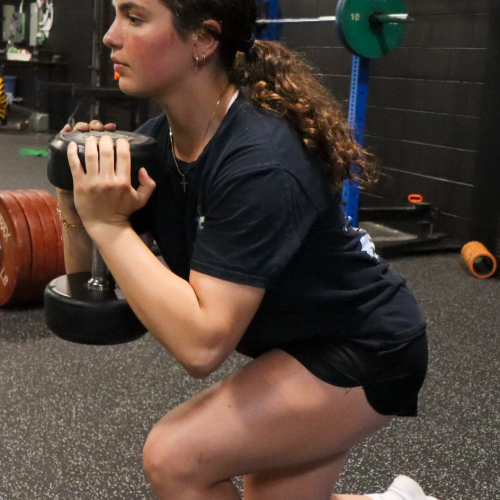
When we wear running shoes for training, those features which help us run efficiently and comfortably, actually inhibit movements such as squats and lunges. Why? Because they do not provide a firm platform for us to push into ground, and the shape forces our weight to go in and forward towards the toes negatively impacting posterior engagement and often balance.
Over the years we have seen both semi-private persona training, and athlete development clients benefit almost instantly in balance exercises by removing their running shoes. First, the removal of the big cushion allows them to feel and squeeze the ground with their foot, allowing for better control. Secondly, they aren’t working AGAINST the U shaped architecture of the shoe.

Which shoes should I get?
If not running shoes, than what shoes SHOULD you get for your training journey? For general purpose training, you want something with a fairly thin and flat sole. Many shoes labelled cross trainer will work, but I would argue still tend to be a little chunky in the heel and often unevenly balanced. To make life easy I would venture to say the safest bet if you are unsure is a low cut basketball shoe.
Basketball shoes typically have good lateral support, a firm and flat sole, and not too much heel lift. These ones from New Balance are a decent option. The drawback to basketball shoes is they do tend to be a little heavier, and often don’t breath as well as other shoes.
Another good option for many people training for general strength and fitness is a court shoe. Again, these typically feature a fairly solid and flat sole. Designed for things like tennis or paddle, they have versatility that allows them to be used in other fitness applications, while transitioning to gym use well. A favourite pair of mine are these from Reebok. Again, much like the basketball shoe, because of the sturdiness of the lateral support, they do give up some breathability.
Finally, we can talk about cross trainers. You would think this category would be immediately the favourite. However, I find cross trainers to be inconsistent in their design and execution. In trying to be something for everything, they often become not good at most things. Too cushioned for heavy lifting, not enough lateral support for change of direction, to clunky for jogging. Of the cross trainers I’ve tried, these from Under Armour are the best shoes for training in this category.
All of the suggestions I’ve given are shoes, or styles that should be readily availble to go try on and pick up at your local retailer. When it comes to training shoes, there are any number of online brands which are more specialized than the big brands. While I have tried some with mixed success, for the purposes of this exercise of recommending shoes for beginners to the gym, I think it’s best to keep it simple and avoid online only brands. Shoes are very personal and highly individual in how they fit your foot, so the ability to see and try on tips the scales.
Choose function over comfort
One word of caution when trying on shoes for training. What feels comfortable in the store walking and standing around, may not feel as comfortable on the training floor. Make sure you prioritize getting the right tool for the job you are expecting it to do. Buying big pillowy HOKAs and then not being able to do a lunge in them, is like being surprised when you try to hammer and nail with a marshmallow.
These observations are my opinion on the best shoes for training, after 15+ years coaching and over 25 years training. This is by no means an exhaustive list, but hopefully can provide a good starting point for those of you looking to start your training journey off on the right foot!
Did you find this information valuable? We would love to hear from you! Send us and email at info@prototypeathlete.com.
Do you live in the Mississauga, Oakville area and are looking for a welcoming community to start your fitness journey? Check out PSP Well semi-private personal training for a better way to reach your goals in a safe, individualized, small group environment.